


Spinal fusion back surgery is often a last resort for workers with a severe spinal injury. The procedure joins vertebrae together to stabilize the spine, but it changes how the back moves forever. Even when it succeeds, workers who have undergone spinal fusion surgery are often left with reduced range of motion, chronic stiffness, or nerve-related pain. Heavy lifting, bending, or twisting may no longer be possible, forcing career changes or early retirement.
Because these outcomes are expensive, insurers and L&I often push workers to settle quickly and cheaply. The real value of a spinal fusion claim depends on the injury severity, how the surgery affects your long-term function, how it is rated under Washington’s system, and whether complications are documented before the workers’ compensation claim closes.
What Is a Spinal Fusion?
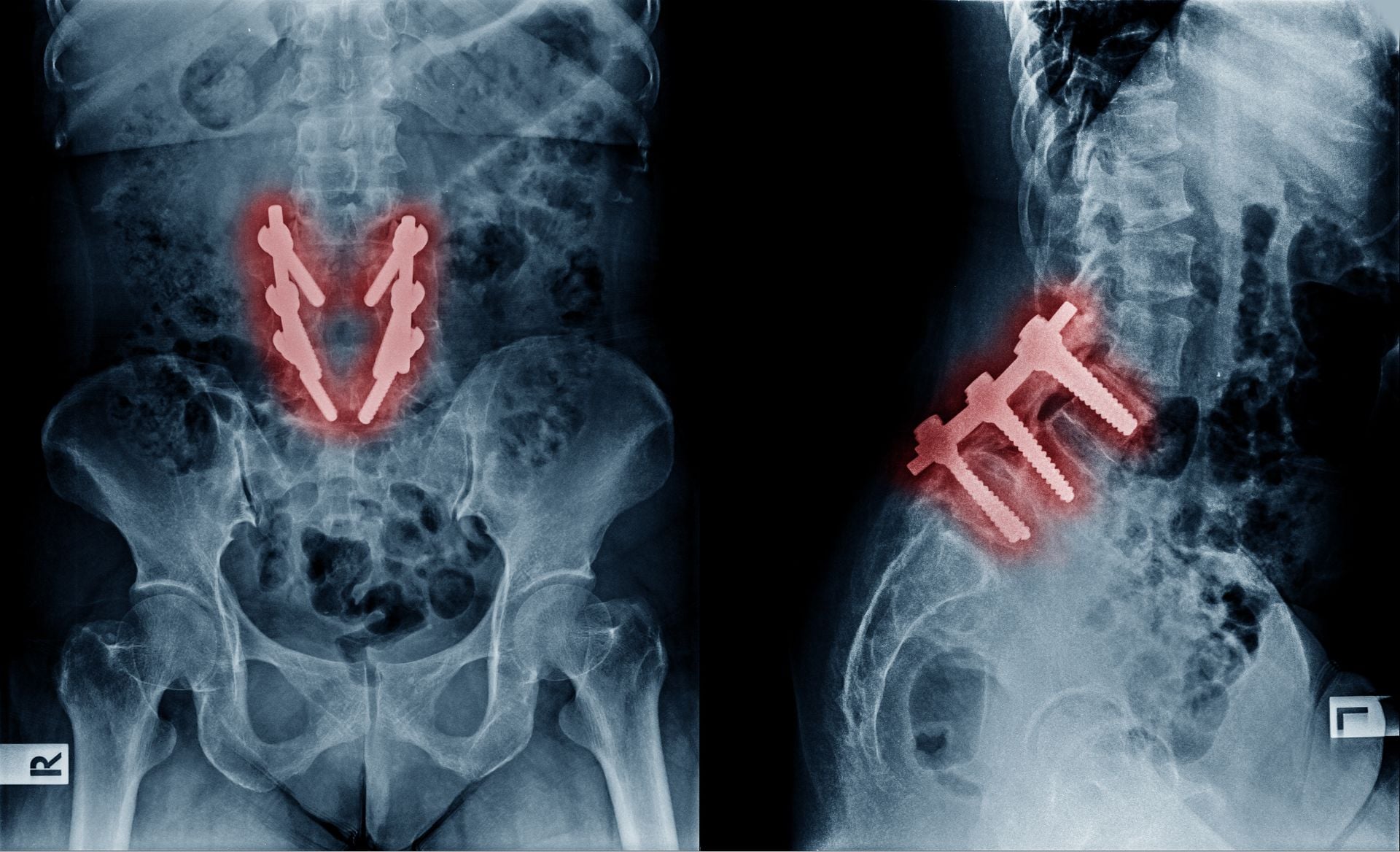
Spinal fusion surgery is a medical procedure in which two or more vertebrae are permanently joined to stabilize the spine, protect the spinal cord, and reduce pain. Surgeons use bone grafts, screws, rods, or cages to hold the vertebrae together until they heal into one solid structure. Motion in the fused section is gone for good, which often limits flexibility and mobility.
Cervical, Thoracic, and Lumbar Spinal Fusion Surgery
Spinal fusions are categorized based on the region of the spine where the surgery is performed. The impact of the procedure depends heavily on location, since different parts of the spine control different movements and functions.
| Type | Description | How It Affects Workers |
|---|---|---|
| Cervical fusion (C1-C7) | Performed in the neck, often for disc herniations or nerve compression. | It can reduce neck rotation and lead to weakness, numbness, or grip loss in the arms and hands. |
| Thoracic fusion (T1-T12) | Done in the mid-back, usually after trauma or deformity. Less common than cervical or lumbar fusions. | Creates stiffness in the torso and reduces twisting ability. |
| Lumbar fusion (L1-S1) | The most common type is often at the L4-L5 or L5-S1 levels. | Limits bending, lifting, and twisting. It can cause difficulty with walking or standing for long periods. |
Another important factor is whether the surgery involves a single-level fusion (fusing two vertebrae) or a multi-level fusion (fusing three or more vertebrae at various levels). Single-level fusions usually allow better recovery and fewer restrictions, while multi-level fusions create more stiffness, higher impairment ratings, and long-term mobility challenges.
Surgical Approaches
Spinal fusion can be performed using different surgical approaches. The path the surgeon takes to access the spine affects how much tissue is disrupted, how long recovery may take, and what complications may develop.
| Approach | Description | Impact on Recovery |
|---|---|---|
| Anterior fusion | A surgeon accesses the spine from the front of the body. | Often less muscle disruption, but it may involve longer healing. |
| Posterior fusion | A surgeon operates from the back of the body. | Common in lumbar cases, with longer recovery due to muscle involvement. |
| 360-degree fusion | Combines anterior and posterior approaches. | Used for severe instability. Typically, has the longest recovery with a higher complication risk. |
Hardware and Bone Grafts
Most spinal fusions rely on hardware and bone grafts to stabilize the spine and help the vertebrae fuse together and heal. These materials improve the success rate of surgery but can also lead to complications if they loosen, break, or fail to fuse properly.
| Type | Description | Risks and Considerations |
|---|---|---|
| Metal plates, rods, screws, cages | Devices used to stabilize the spine during healing. | Hardware can loosen, break, or require removal if complications arise. |
| Bone grafts (autograft or allograft) | Bone material used to help vertebrae fuse, taken from the patient or a donor. | May fail to heal (non-union), leading to revision surgery. |
Back Conditions That May Lead to Spinal Fusion
Spinal fusion is rarely the first choice for treating back problems. Most doctors recommend that workers try conservative care such as physical therapy, medications, or injections before surgery is considered. But when these treatments fail, and the spine remains unstable or painful, fusion may become necessary. Several conditions can lead to this point, including:
- Degenerative disc disease: When spinal discs wear down over time, they lose height and cushioning, which can create instability and chronic pain. Fusion may be required to restore stability.
- Neck injury: Trauma to the cervical spine can cause fractures, herniated discs, or instability that require surgical stabilization.
- Spinal stenosis: Narrowing of the spinal canal can compress nerves, often causing leg pain, weakness, or numbness. In severe cases, fusion is performed after decompression to prevent further damage.
- Herniated discs and spinal disc leaks: When a disc ruptures or leaks fluid, nearby nerves can be compressed or chemically irritated. This often causes significant pain, weakness, or numbness. If conservative care or disc removal does not resolve the issue, spinal fusion may be required to restore stability.
- Inflammation and nerve irritation: Chronic inflammation around the spine may compress or damage nerves, leaving lasting deficits that sometimes require spinal fusion surgery to stabilize.
- Spinal fractures: Severe fractures from falls, crashes, or heavy impacts can destabilize the spine, leaving fusion as the only option to restore structural integrity and protect the spinal cord.
- Scoliosis: Abnormal curvature of the spine can progress to the point that multi-level fusion is required to restore alignment and stability.
- Spondylolisthesis: A vertebra slipping forward out of place creates instability that often leads to fusion when conservative care fails.
- Spinal tumors or infections: Though less common, these conditions can damage vertebrae or discs, requiring removal and stabilization through fusion.
These conditions highlight why fusion is considered a last resort. It is often only recommended when the spine cannot remain stable or functional without surgical support.
Average Workers’ Compensation Settlement Amounts
There is no single “average” number that applies to every spinal fusion claim. Settlement value depends on the type of fusion performed, the number of spinal levels involved, whether complications develop, and how the injury affects long-term work capacity.
Looking at national data gives a general starting point, but Washington’s workers’ compensation system calculates awards differently. Across the U.S., the average workers’ compensation settlement for spinal fusion surgery often falls between $50,000 and $400,000. These figures reflect nationwide trends but do not directly control how Washington pays claims.
How Spinal Fusion Injuries Are Rated in Washington’s PPD System
Washington doesn’t determine spinal fusion settlements the same way most states do. Instead of relying on broad averages, the Department of Labor and Industries (L&I) uses the current Permanent Partial Disability (PPD) schedule, which assigns a percentage of total body impairment (%TBI) to each injury.
That percentage is then converted into a dollar award based on the schedule in effect on your date of injury. For July 1, 2025, through June 30, 2026, 100% TBI is valued at $264,332.13. Claim closing and PPD awards are usually determined when a worker reaches maximum medical improvement, meaning no further healing or improvement is expected. At this point, all medical findings related to the accepted conditions are considered in the evaluation, and the injury is categorized. Each category represents a level of permanent impairment, with higher categories reflecting more severe functional loss and resulting in higher compensation.
Below are the categories that typically apply in spinal fusion cases, broken down by region of the spine.
Cervical and Cervicodorsal Fusions (Neck)
Cervical and cervicodorsal fusions cover injuries and surgeries in the neck and upper spine. These are common after herniated discs or nerve compression that require stabilization. Because the neck is critical for motion and nerve function in the arms, even partial impairment can result in significant compensation.
| Category | % of TBI | Award |
|---|---|---|
| 2 | 10% | $26,433.21 |
| 3 | 20% | $52,866.42 |
| 4 | 25% | $66,083.04 |
| 5 | 35% | $92,516.25 |
The information in these charts and the dollar figures listed are provided to help readers evaluate their claims. There is no guarantee that your claim will produce the same results. Past outcomes do not ensure future success. Each case is unique and will be evaluated independently. Your outcome will depend on various factors, including the facts, the law, timeliness, advocacy, and unforeseen circumstances.
The information on this website is provided to help interested persons understand the role that legal services play in the claim process. This data is intended solely for informational purposes and does not constitute legal advice. It is not a replacement for consultation with a qualified attorney about your specific legal situation. Click here for a free consultation with an attorney.
The following scenarios show how cervical back injuries are typically rated depending on the number of levels fused and the degree of lasting impairment.
- A worker with a single-level cervical fusion who regains most motion may be rated at Category 2.
- A multi-level cervical fusion that leaves reduced rotation and numbness in the arms could fall under Category 3 or 4.
- A worker who undergoes extensive cervical fusion and is left with severe stiffness and permanent arm weakness may qualify for Category 3, 4, or 5.
Dorsal Fusions (Mid-Back)
Dorsal (thoracic) fusions are less common but usually occur after trauma or deformity. They can leave a worker with severe stiffness in the torso and reduced ability to twist or bend.
| Category | % of TBI | Award |
|---|---|---|
| 2 | 10% | $26,433.21 |
| 3 | 20% | $52,866.42 |
The information in these charts and the dollar figures listed are provided to help readers evaluate their claims. There is no guarantee that your claim will produce the same results. Past outcomes do not ensure future success. Each case is unique and will be evaluated independently. Your outcome will depend on various factors, including the facts, the law, timeliness, advocacy, and unforeseen circumstances.
The information on this website is provided to help interested persons understand the role that legal services play in the claim process. This data is intended solely for informational purposes and does not constitute legal advice. It is not a replacement for consultation with a qualified attorney about your specific legal situation. Click here for a free consultation with an attorney.
These examples show how thoracic fusion cases are commonly classified under Washington’s PPD schedule.
- A thoracic fusion after a traumatic fracture with partial stiffness may be rated at Category 2.
- A multi-level thoracic fusion causing permanent torso rigidity could rise to Category 3.
- A worker whose thoracic fusion results in lasting posture and breathing issues may also qualify for Category 3.
Dorsolumbar and Lumbosacral Fusions (Lower Back)
Dorsolumbar and lumbosacral fusions are the most common spinal fusions in workers’ compensation. These typically involve the lower spine (L1-S1) and can drastically affect a worker’s ability to lift, bend, or stand for long periods. Because the lower spine bears the body’s weight and is essential for lifting, bending, and supporting movement, these cases often carry higher impairment ratings for heavy labor jobs.
| Category | % of TBI | Award |
|---|---|---|
| 2 | 5% | $13,216.62 |
| 3 | 10% | $26,433.21 |
| 4 | 15% | $39,649.83 |
| 5 | 25% | $66,083.04 |
| 6 | 40% | $105,732.84 |
| 7 | 60% | $158,599.29 |
| 8 | 75% | $198,249.09 |
The information in these charts and the dollar figures listed are provided to help readers evaluate their claims. There is no guarantee that your claim will produce the same results. Past outcomes do not ensure future success. Each case is unique and will be evaluated independently. Your outcome will depend on various factors, including the facts, the law, timeliness, advocacy, and unforeseen circumstances.
The information on this website is provided to help interested persons understand the role that legal services play in the claim process. This data is intended solely for informational purposes and does not constitute legal advice. It is not a replacement for consultation with a qualified attorney about your specific legal situation. Click here for a free consultation with an attorney.
These examples illustrate how lumbar fusion ratings increase with the number of levels fused and the severity of long-term restrictions.
- A single-level lumbar fusion that heals well but leaves mild bending limits may be rated at Category 2 or 3.
- A two-level lumbar fusion with chronic stiffness and nerve pain may be rated at Category 3, 4, or 5.
- A worker with a multi-level lumbosacral fusion who cannot return to heavy labor may fall into a higher category rating, depending on documented loss of function. If he will never work again, then he should push for a pension and not a PPD settlement.
What other benefits exist besides the PPD award?
While the PPD schedule limits impairment awards, the potential total L&I payout of a spinal fusion claim can go well beyond the category rating system when other benefits and legal options are considered:
- Time-loss benefits during recovery, which replace wages while you are unable to work.
- Loss of earning power (LEP) benefits while the claim is open if you return to a lower-paying job due to physical restrictions.
- L&I pensions for workers permanently unable to work, which provide lifetime monthly payments often worth far more than a PPD award.
- Claim Resolution Settlement Agreements (CRSAs) in negotiated cases, which can produce structured or lump-sum settlements beyond standard PPD.
- Third-party settlements if another company or party (such as a contractor, equipment manufacturer, or negligent driver) contributed to the injury, allowing recovery outside of L&I’s limits. Unlike L&I, which only allows the recovery of economic damages like medical expenses, lost wages, etc., third-party claims allow workers to recover substantial non-economic damages, such as pain and suffering.
Failed Back Syndrome and Other Long-Term Consequences of Spinal Fusion

Spinal fusion surgery is performed to stabilize the spine and reduce pain, but in some cases, it creates a new set of problems that may last a lifetime.
The most recognized of these is failed back syndrome (FBS), a condition where the surgery does not relieve symptoms or makes them worse. Workers with FBS often live with persistent pain in the back or legs, limited mobility, and reduced ability to work. Many cannot return to their prior jobs, especially if the work involved heavy labor, bending, or lifting. In the most severe cases, additional fusion or revision surgeries are required, each increasing future medical expenses, carrying greater risks, and higher impairment ratings.
When properly documented, failed back syndrome can substantially increase the value of a spinal fusion PPD award.
Additional Long-Term Consequences
Beyond failed back syndrome, spinal fusion can also lead to other lasting complications that affect how workers move, work, and live:
- Hardware failure: Plates, screws, or rods may loosen, shift, or break, sometimes requiring more surgery.
- Adjacent segment disease: Added stress on nearby vertebrae often leads to degeneration above or below the fusion.
- Chronic pain: Nerve irritation, scar tissue, or muscle changes can leave workers in pain long after healing, sometimes requiring epidural steroid injections and complete dependence on anti-inflammatory pain medication to manage symptoms and alleviate pain.
- Loss of flexibility and mobility: A fused segment no longer bends, limiting lifting, twisting, and prolonged standing or sitting.
- Use of assistive devices: Some workers must rely on canes, walkers, or braces for support, increasing future medical costs.
- Revision surgery: Fusions can fail to heal fully (pseudoarthrosis) or wear out, leading to repeat future surgeries.
- Nerve damage or radiculopathy: Spinal nerves may be injured, causing numbness, weakness, or radiating pain.
- Muscle weakness and atrophy: Reduced motion can weaken surrounding muscles, lowering strength and endurance.
- Gait changes and joint strain: Altered walking or posture may create problems in the hips, knees, or shoulders.
- Arthritis and degeneration: The altered mechanics of the spine often encourage arthritis in nearby joints, adding to medical costs over time.
- Infection or non-healing wounds: Though less common, post-surgical infections may leave permanent damage.
Traps You Should Avoid in a Spinal Fusion Claim
Spinal fusion cases are some of the most expensive claims in Washington’s workers’ comp system, which means insurers look for every chance to cut costs. An experienced lawyer helps you avoid these common traps:
- Settling too early: A lawyer keeps your claim open long enough to account for complications that may appear months or years after an injury.
- Low impairment ratings: Legal support ensures your doctor’s rating includes nerve damage, mobility loss, and other secondary impairments that affect your workers’ compensation benefits.
- Biased IMEs: A lawyer can challenge independent medical exams that downplay your permanent restrictions.
- Missed reopening deadlines: Legal guidance makes sure you file on time if your condition worsens and the claim needs to be reopened.
- Failure to document pain: A lawyer pushes for medical records that capture ongoing pain so it cannot be dismissed as “subjective.”
- Ignored adjacent segment disease: Legal advocacy ensures new degeneration above or below the fused levels is added to your claim.
- Undervalued vocational impact: A lawyer fights for vocational rehabilitation benefits, permanent disability benefits, or a pension when you can’t return to heavy work.
- Minimized secondary conditions: Legal support helps document and rate issues like gait changes, hip strain, or knee problems caused by stiffness.
- Incomplete surgical records: A lawyer gathers surgical reports and specialist opinions to make sure nothing is left out of your rating.
- Blaming pre-existing conditions: An attorney rebuts arguments that your spinal issues are “age-related” instead of caused or worsened by your job, protecting both temporary disability benefits and long-term awards.
With the support of an experienced workers’ compensation attorney, these traps turn from dead ends to opportunities to secure the full compensation you deserve.
Get Help With Your Spinal Fusion Claim Before It’s Too Late
If you had spinal fusion surgery because of a workplace injury, you are facing one of the most serious claims in Washington’s workers’ comp system. Insurers will do everything they can to close your case quickly and pay you less than what your injury is truly worth. Without strong medical documentation and legal guidance, most workers end up with only a fraction of the compensation they deserve.
At our Law Firm, we focus on protecting injured workers across Washington. We know how L&I values spinal fusion claims, how to challenge low impairment ratings, and how to keep claims open long enough to document and treat long-term complications. We review claims for free, explain what your case may really be worth, and fight to secure every dollar you’re entitled to.
You don’t pay us unless we win for you. Don’t let L&I or your employer decide the value of your future. Call today for a free consultation and find out what your spinal fusion claim is really worth.