


The nerve damage, stiffness, pain, and weakness that result from a bulging or herniated disc can wreck your ability to work and live normally. In Washington, the value of the average workers’ compensation settlement for a bulging disc depends on how severe the injury is, what level of the spine is injured, how well it’s documented, and whether you push back when L&I tries to dismiss it as “degenerative” or “age-related.” Without a clear understanding of how these claims are calculated, too many injured workers accept lowball closures and walk away with an injury settlement that doesn’t come close to covering their future medical expenses, lost wages, or permanent disability benefits.
What Bulging Disc Injuries Qualify for Workers’ Compensation?
If an injury, or years of heavy lifting, twisting, or sitting in awkward positions on the job, caused your bulging disc or made your back condition worse, you may have a valid claim for workers’ compensation benefits in Washington. Disc injuries are common in construction, warehousing, trucking, nursing, and even office work, where poor posture or repetitive strain can wear down the spine. Whether your disc damage came from one sudden accident or developed slowly over time, the law covers it if the medical evidence ties it to your work.
Here are the most common bulging disc injuries and surgical procedures seen in workplace injuries:
| Category | Injury or Procedure | Description |
|---|---|---|
| Disc injuries | Lumbar bulging disc | A disc pushes into the spinal canal in the lower back, causing back or leg pain, weakness, or sciatica. |
| Cervical bulging disc | A Disc bulge in the neck, compressing nerves, leading to arm pain, numbness, or weakness. | |
| Thoracic bulging disc | Less common but can cause mid-back pain and nerve symptoms in the chest or ribs. | |
| Complications | Herniated disc (ruptured disc) | The inside of the disc leaks, pressing on the nerves, often more severe than a bulge. |
| Annular tear | Tear in the disc’s outer layer, often linked to sudden lifting injuries. | |
| Spinal stenosis | Narrowing of the spinal canal from a disc bulge, causing nerve compression. | |
| Nerve conditions | Radiculopathy/sciatica | Nerve pain shooting down arms or legs from disc pressure. |
| Chronic pain syndrome | Long-term pain even after treatment is often linked to disc damage. | |
| Non-surgical treatments | Physical therapy | Exercises to strengthen the spine and reduce symptoms. |
| Epidural steroid injections | Injections to reduce inflammation and nerve pain. | |
| Surgeries | Discectomy/microdiscectomy | Removal of disc material pressing on a nerve. |
| Laminectomy | Removing part of the vertebra to relieve nerve pressure. | |
| Spinal fusion | Joining vertebrae together to stabilize the spine after disc damage. | |
| Artificial disc replacement | Replacing a damaged disc with an implant to restore motion. | |
| Revision spine surgery | Corrective surgery when prior procedures fail. |
The Difference Between Bulging and Herniated Discs
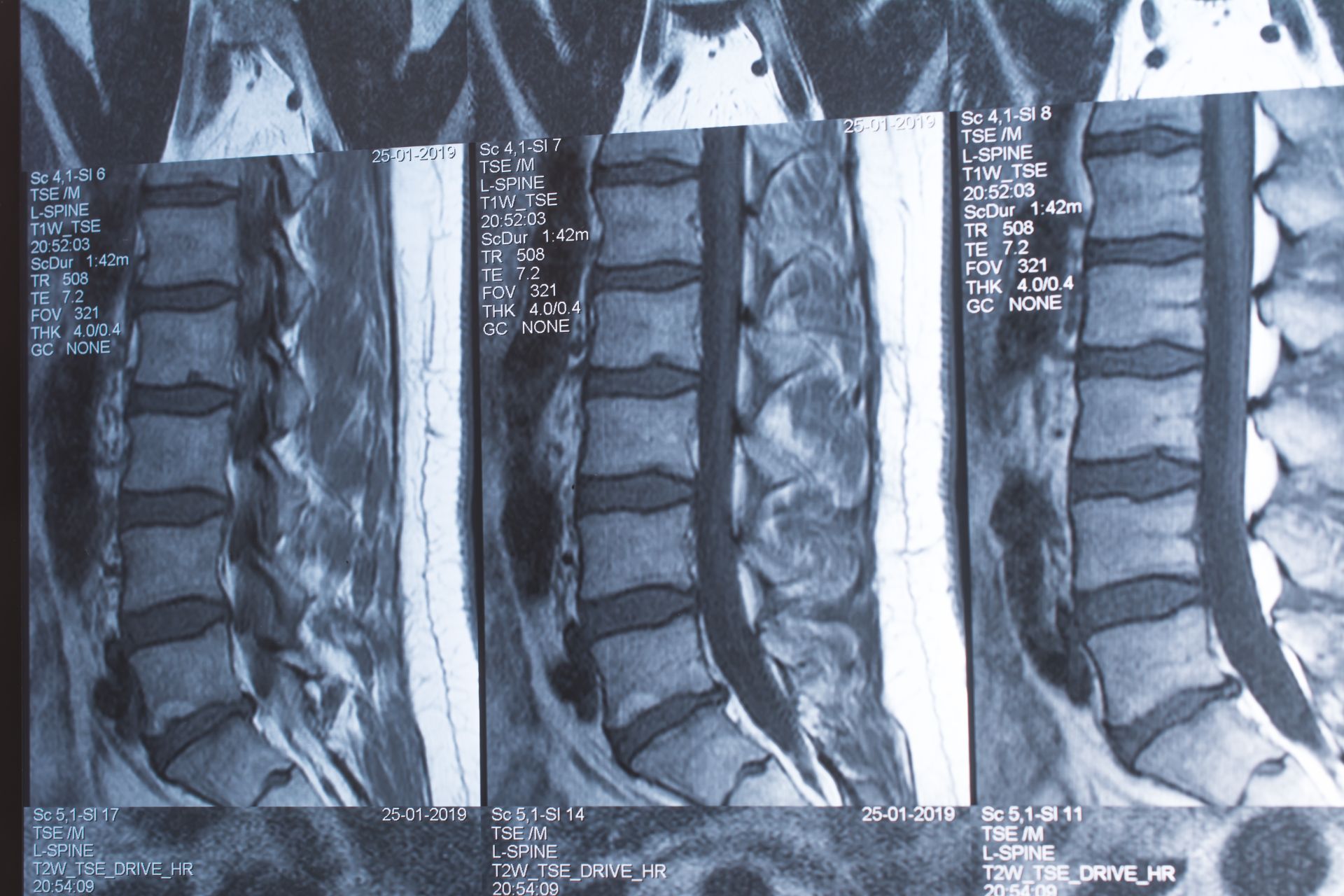
The terms “bulging discs” and “herniated disc injuries” are often used interchangeably, but they’re not the same, and the difference matters in a back injury settlement.
- A bulging disc happens when the disc shifts outward, but the outer wall of the disc remains intact. Sometimes bulges cause no symptoms at all. At other times, they press on a nerve root, triggering sciatica, numbness, or weakness. Insurers often call them “degenerative” or “age-related” to downplay their seriousness. However, the reality is that a bulging disc can still limit your ability to work and may require ongoing medical benefits such as therapy, injections, or other treatment. That said, bulging discs can improve with rest and non-surgical care.
- A herniated disc is more severe. The outer wall of the disc tears, and the soft inner material leaks out into the spinal canal. This increases the chance of nerve compression and severe pain, plus it means the disc has lost some of its structure and cushioning. Small disc herniations can sometimes improve over time as the body reabsorbs leaked material, but the disc never fully heals to its original state. Larger herniations often require back surgery, and even after treatment, they leave workers at higher risk of repeat herniations, arthritis, or chronic disability.
That permanent structural damage is why herniated disc cases are typically rated higher under Washington’s impairment categories and lead to larger settlements. Bulging discs can still qualify for meaningful awards, especially if they cause nerve symptoms or work restrictions, but herniations carry more weight because they represent a permanent structural failure of the spine.
What Is the Average Workers’ Comp Settlement for Bulging Disc Injuries?
There’s no single “average” payout for spinal disc injuries, but national data gives a helpful frame of reference. The National Safety Council reports the average cost of a lower back injury at $40,409, an upper back injury at $37,320, and even less severe soft-tissue categories like lacerations, punctures, and ruptures at $32,796. These numbers show the baseline medical care costs insurers expect when a back claim is filed.
For bulging discs, most settlements nationwide fall within these ranges. When treatment is limited to therapy or injections, payouts are modest because objective medical findings are minimal. But when a bulge compresses a nerve, causes sciatica, or forces permanent restrictions, settlements can rise considerably. In these cases, future medical concerns may also arise.
Workers with herniated discs see higher settlements. A herniation is a structural failure of the disc, often requiring surgery and carrying long-term risks. The range of settlements for herniated disc injuries can be between $0 and $92,000. Cases involving spinal fusion or multiple surgeries are often at the high end of the range.
The real question is how your injury is measured under Washington’s permanent partial disability (PPD) system. Instead of relying on national averages, the Washington Department of Labor and Industries (L&I) looks at medical ratings, loss of function, and the percentage of your body that’s impaired. That rating is what drives your award, not the national figures.
How Bulging Disc Injuries Are Rated in Washington’s PPD System

Washington L&I uses a chart called the Permanent Partial Disability (PPD) award schedule. That chart assigns a dollar amount to different categories of impairment. The worse your injury, the higher the category, and the more money you’re paid.
For the spine, the maximum payout, or 100% total bodily impairment, is $264,332.13 for the 2025 through 2026 payment rates. Nobody gets that much because for an injury so severe, the award is usually a pension. Any injury less severe is rated at a percentage of that number expressed as a category number.
Bulging discs are usually rated in Category 2 or 3, depending on severity. Herniated discs, by contrast, can qualify as high as Category 4 or 5 when nerve damage, weakness, or loss of function is documented. Where you land depends on MRIs, nerve studies, and whether your doctor will stand up and speak out against an L&I IME.
Because several factors go into these ratings, including imaging, clinical findings, and your work restrictions, the outcome can vary widely between two people with the same diagnosis.
Cervical and Cervicodorsal Spine Injuries
Neck bulging discs can limit rotation, grip strength, and even arm function. These injuries often require surgeries like cervical fusion, disc replacement, or decompression to relieve nerve pressure. Here is the current 2025 award schedule for cervical and cervicodorsal spine injuries:
| Category | % of TBI | Payout |
|---|---|---|
| Category 2 | 10% | $26,433.21 |
| Category 3 | 20% | $52,866.42 |
| Category 4 | 25% | $66,083.04 |
| Category 5 | 35% | $92,516.25 |
The information in these charts and the dollar figures listed are provided to help readers evaluate their claims. There is no guarantee that your claim will produce the same results. Past outcomes do not ensure future success. Each case is unique and will be evaluated independently. Your outcome will depend on various factors, including the facts, the law, timeliness, advocacy, and unforeseen circumstances.
The information on this website is provided to help interested persons understand the role that legal services play in the claim process. This data is intended solely for informational purposes and does not constitute legal advice. It is not a replacement for consultation with a qualified attorney about your specific legal situation. Click here for a free consultation with an attorney.
Bulging discs in the cervical spine are usually rated Category 2 or 3, with awards ranging from $26,433 to $52,866. Herniated disc cases with lasting nerve damage or weakness can reach Category 4 or 5, where awards climb above $66,000 and in rare cases, may exceed $90,000.
Dorsal Spine Injuries
Bulging discs in the thoracic spine (mid-back) are less common but can be life-changing. Trauma here can affect your ability to twist, lift, or even breathe deeply if the ribs are involved. Surgeries like decompression or stabilization are sometimes required. Here is the 2025 award schedule for dorsal spine injuries:
| Category | % of TBI | Payout |
|---|---|---|
| Category 2 | 10% | $26,433.21 |
| Category 3 | 20% | $52,866.42 |
The information in these charts and the dollar figures listed are provided to help readers evaluate their claims. There is no guarantee that your claim will produce the same results. Past outcomes do not ensure future success. Each case is unique and will be evaluated independently. Your outcome will depend on various factors, including the facts, the law, timeliness, advocacy, and unforeseen circumstances.
The information on this website is provided to help interested persons understand the role that legal services play in the claim process. This data is intended solely for informational purposes and does not constitute legal advice. It is not a replacement for consultation with a qualified attorney about your specific legal situation. Click here for a free consultation with an attorney.
Bulging discs here are almost always rated Category 2 or 3, with awards in the $26,433-$52,866 range. Disc herniations with objective nerve involvement may be pushed into higher categories, but strong imaging and clinical findings are essential to justify it.
Dorsolumbar and Lumbosacral Spine Injuries
Most bulging disc injuries involve the lower back, which absorbs the strain of lifting, bending, and twisting. Damage here often makes even basic movements painful. Severe cases require laminectomy, fusion, or disc replacement surgery. Here is the current award schedule for dorsolumbar and lumbosacral spine injuries:
| Category | % of TBI | Payout |
|---|---|---|
| Category 2 | 5% | $13,216.62 |
| Category 3 | 10% | $26,433.21 |
| Category 4 | 15% | $39,649.83 |
| Category 5 | 25% | $66,083.04 |
| Category 6 | 40% | $105,732.84 |
| Category 7 | 60% | $158,599.29 |
| Category 8 | 75% | $198,249.09 |
The information in these charts and the dollar figures listed are provided to help readers evaluate their claims. There is no guarantee that your claim will produce the same results. Past outcomes do not ensure future success. Each case is unique and will be evaluated independently. Your outcome will depend on various factors, including the facts, the law, timeliness, advocacy, and unforeseen circumstances.
The information on this website is provided to help interested persons understand the role that legal services play in the claim process. This data is intended solely for informational purposes and does not constitute legal advice. It is not a replacement for consultation with a qualified attorney about your specific legal situation. Click here for a free consultation with an attorney.
Bulging discs in the lumbar spine are typically rated Category 2 or 3, with awards between $13,216 and $26,433. Herniated disc injuries that cause lasting nerve damage, weakness, or require surgery often fall in Category 4 or 5, paying $39,650-$66,083. Catastrophic herniations with permanent impairment can go even higher, into Category 6 or 7, driving six-figure payouts.
Factors That Influence Bulging Disc Settlement Amounts
Not all bulging disc injuries have the same settlement value. Some injuries are minor annoyances, while others wreck a person’s career and require multiple surgeries. Here’s the range of severity and how each step changes the claim:
- Mild bulging disc: The disc protrudes slightly beyond its normal space but doesn’t compress a nerve. Symptoms are mostly stiffness or occasional pain. Usually treated with rest, physical therapy, and maybe an injection. These cases fall on the low end of settlements and may be zero.
- Bulging disc with nerve involvement: The bulge presses on a nerve root, causing pain, numbness, or weakness in the arms or legs. Ability to work decreases, and impairment ratings climb. Settlements increase with stronger medical evidence.
- Herniated disc: The disc wall tears and material leaks out, often compressing nerves and causing severe sciatica or radiculopathy. These cases are more likely to require surgery and push awards into the mid- to high-range of workers’ compensation benefits.
- Surgical intervention (discectomy or laminectomy): When conservative care fails, surgery to remove disc material or relieve pressure becomes necessary. Recovery is long, permanent restrictions are common, and settlement values rise, often requiring coverage of future medical care.
- Spinal fusion: A drastic procedure that locks vertebrae together to stabilize the spine. It permanently limits motion and often causes future stress on other discs. These cases often trigger larger awards and usually include temporary disability benefits or retraining if the worker can’t return to heavy labor.
Failed Back Surgery Syndrome (FBSS) and What It Means for Workers’ Comp Claims
When back surgery doesn’t fix the problem or makes it worse, you’ve entered the worst territory in back injury claims: failed back surgery syndrome (FBSS).
It’s a condition that can happen when patients continue or begin to have debilitating pain after one or more spinal surgeries. It’s not rare. Studies estimate that 10% to 40% of patients end up with FBSS following lumbar spine surgery. In concrete terms, only about 60% of back surgeries succeed, meaning up to 40% fail to relieve pain or restore function. That failure isn’t just a medical setback. It’s devastating for a workers’ comp claimant. Instead of a quick solution, you’re dealing with:
- Increased impairment ratings.
- Frequent need for pain management, assistive devices, or even further surgeries.
- An extended or permanent absence from work that brings vocational rehabilitation or continuing wage loss benefits into play.
In simple terms, if your first back surgery didn’t help or made things worse, you may need to consult with an attorney. At some point, you may qualify for a pension.
How a Seattle Workers’ Compensation Lawyer Can Help
Bulging disc claims are exactly the kind L&I love to contest. They’ll say your pain is “degenerative,” your MRI shows “normal aging,” or your impairment is just a Category 2 when it should be a Category 3 or higher. Without someone fighting on your behalf, you get stuck with the lowest possible payout. Here’s where a lawyer makes the difference:
- Challenging low ratings: If L&I or the insurer’s IME downplays your loss of motion, nerve symptoms, or documented impairment, an attorney can demand a fair examination and force a higher rating.
- Blocking lowball settlements: Lawyers know the true value of bulging disc claims and won’t let you settle before you are given a fair PPD rating.
- Pushing back on independent medical exams: Independent Medical Examiners (IME) almost always side with the insurer. A lawyer makes sure your doctor’s opinion isn’t buried in settlement negotiations.
- Securing vocational benefits: If your back injury means you can’t return to any job, attorneys fight for retraining or lump sum payment options.
- Proving work-relatedness: Insurers love to blame bulging discs on pre-existing injuries. Attorneys link your job duties and medical evidence to prove the injury is compensable.
- Coordinating with medical providers: Lawyers make sure your doctors understand the L&I lingo and use the right terms and impairment categories.
- Appealing denials: If your claim is rejected, a lawyer manages protests, appeals, and hearings before the Board of Industrial Insurance Appeals (BIIA).
- Fighting misclassification: If you’re called an independent contractor, a lawyer can prove you were really an employee and entitled to workers’ compensation benefits.
- Negotiating settlements: Attorneys can push for structured payouts, such as a CRSA, when it would be to your advantage.
Get a Fair Settlement by Working With a Washington Workers’ Comp Attorney
A bulging disc can leave you with pain, weakness, and limitations that never fully go away. That makes your claim valuable, but insurers will seldom pay that value voluntarily. Their goal is to close your case fast and cheaply, often before your injuries have fully healed.
At Sharpe Law Firm, we fight back. Our law firm challenges low impairment ratings, demands second medical opinions, and reopens claims when your condition gets worse. We push for retraining, financial compensation, and wage loss compensation when you can’t return to your old job. In cases where the injury leads to surgery, fusion, or permanent disability, we make sure the payout reflects the true value of your impairment.
You don’t pay us unless we increase your benefits. If you’re unsure whether your settlement offer is fair, or whether your doctor’s rating really matches what you’ve lost, get in touch. A free consultation can give you answers before you sign away your future.