


A work-related concussion can change how you think, focus, and function long after the accident is over. Even when you look fine, or your scans are normal, persistent headaches, brain fog, memory problems, and emotional changes can make it harder to do your job and live your life. If that happens to you, you have the right to compensation. Injured workers who understand how concussion claims are valued can then stand their ground and be in the best position to recover what their injury is actually worth.
What Counts as a Concussion Under Washington Workers’ Comp Law
Under Washington workers’ compensation law, a concussion is a brain injury caused by a blow, jolt, or sudden movement of the head that disrupts normal brain function.
You do not have to lose consciousness. You do not need a skull fracture. You do not need an abnormal CT scan or MRI to have a concussion.
If your brain function changes because of a workplace head injury, that can qualify as a compensable concussion. A concussion will show up with many possible symptoms, including:
- Memory problems or forgetfulness
- Difficulty concentrating or processing information
- Persistent headaches or head pressure
- Brain fog or mental fatigue
- Sensitivity to light or noise
- Sleep disruption
- Emotional changes such as irritability, anxiety, or mood swings
Labor and Industries (L&I) often treats concussions as minor workplace accidents because these symptoms are subjective and hard to measure. That does not change the legal standard. What matters is whether the symptoms are causally connected to your job injury and whether they affect your ability to work or function normally.
Additionally, Washington law also allows compensation when a work injury aggravates a prior condition. If you had a previous concussion or head injury and a work incident made your symptoms worse, that aggravation can still be compensable. Labor and Industries routinely resists these claims, but the law is on the worker’s side when medical evidence supports the connection.
A concussion does not need to look serious to be legally important. The label L&I uses matters far less than the impairment you are left with and the functional impact the injury has on your ability to do your job. This is what ultimately drives whether a concussion claim results in real compensation and workers’ comp benefits or gets ignored and downplayed.
What Is the Average Workers’ Comp Settlement for a Concussion in Washington?
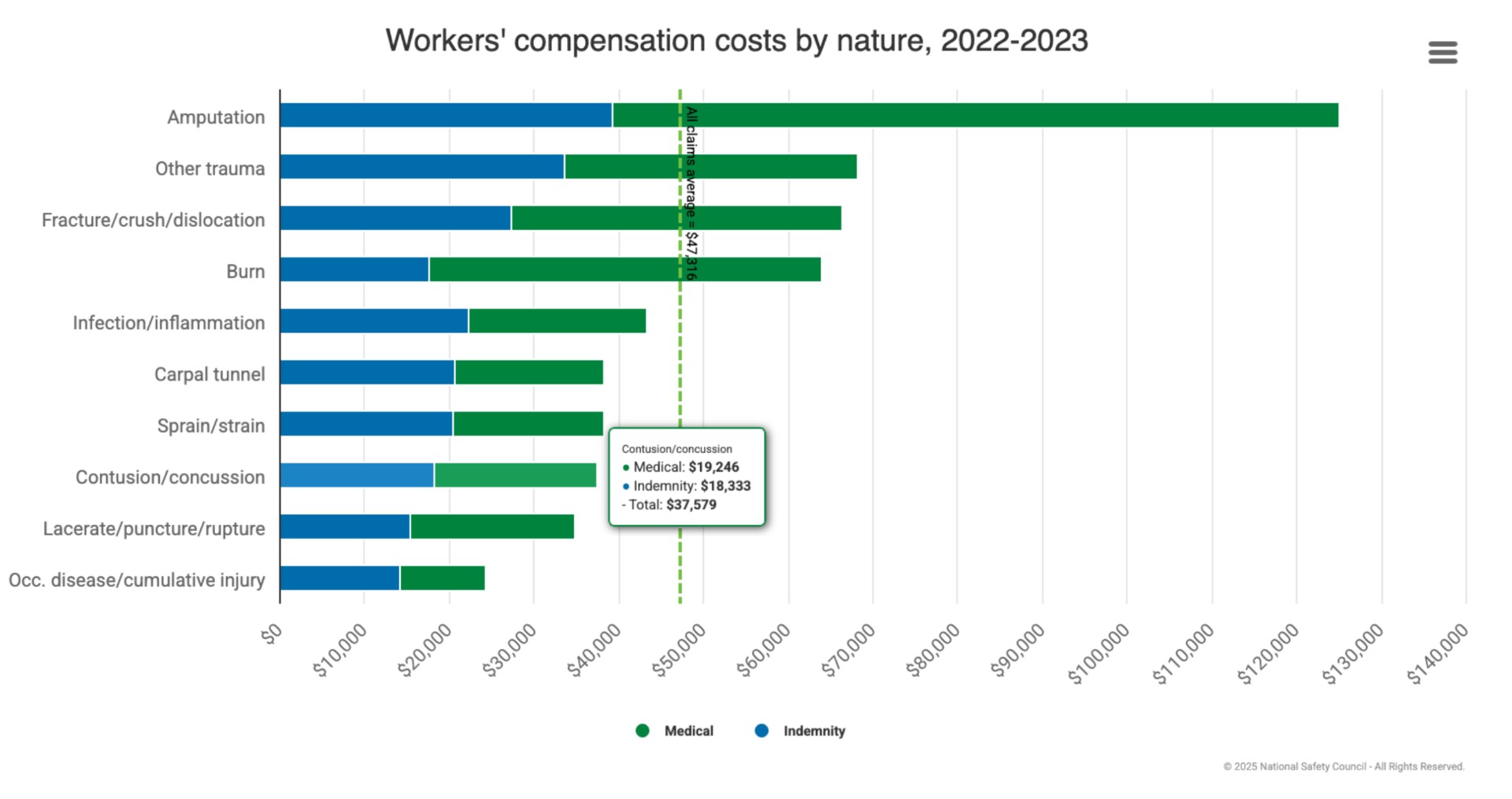
According to National Safety Council data, the average workers’ compensation cost for contusion and concussion claims is about $37,579, consisting of roughly $19,246 in medical treatment costs and $18,333 in wage-loss benefits. However, that figure reflects what workers’ comp systems actually pay on average for concussion-type injuries, not average settlement amounts injured workers are offered or guaranteed. Concussion claims that resolve without permanent impairment often fall below this average and close with only medical care, short-term wage replacement, and no settlement. Claims that also result in a permanent partial disability rating will have a higher value.
How Concussions Are Rated Under Washington’s Permanent Partial Disability (PPD) System
In Washington, a concussion claim is valued based on permanent functional impairment. If your condition stabilizes and you are left with lasting limitations at maximum medical improvement, you may qualify for a Permanent Partial Disability (PPD) award under the state schedule.
Unlike many orthopedic injuries, a concussion claim is not automatically tied to one fixed payout. The value depends on what impairment categories apply and whether the lasting impact is properly documented and rated before the claim is closed.
Mental Impairment
For concussion injuries, the mental impairment schedule is usually the primary determinant of settlement value. Even when a concussion is described as “mild,” it can still qualify for a mental impairment rating when symptoms persist and create permanent functional loss.
Under the current PPD schedule, the maximum compensation for mental impairment is $185,032.50. L&I concussion awards are paid as a percentage of that amount based on the severity and permanence of the impairment.
| Category | Percent Impairment | Award |
|---|---|---|
| 2 | 10% | $26,433.21 |
| 3 | 25% | $66,083.04 |
| 4 | 45% | $118,949.46 |
| 5 | 70% | $185,032.50 |
The information in these charts and the dollar figures listed are provided to help readers evaluate their claims. There is no guarantee that your claim will produce the same results. Past outcomes do not ensure future success. Each case is unique and will be evaluated independently. Your outcome will depend on various factors, including the facts, the law, timeliness, advocacy, and unforeseen circumstances.
The information on this website is provided to help interested persons understand the role that legal services play in the claim process. This data is intended solely for informational purposes and does not constitute legal advice. It is not a replacement for consultation with a qualified attorney about your specific legal situation. Click here for a free consultation with an attorney.
Most concussion claims that qualify for permanent disability fall into Categories 2 through 4, depending on how much cognitive endurance, efficiency, and emotional control have been lost. Category 5 ratings are uncommon for concussions and generally involve far more severe and pervasive impairment.
Mental Impairment Example
A warehouse worker suffers a concussion after a fall accident:
- If the worker has persistent but mild symptoms such as headaches, mental fatigue, or reduced concentration that make work harder but still allow full-time employment, the injury might fall under a Category 2 rating (10%), resulting in a PPD award of about $26,433.21.
- If the worker develops moderate, ongoing cognitive or emotional limitations such as memory problems, slowed thinking, or difficulty keeping up with normal work demands, often requiring modified duties or a reduced pace, the injury may qualify for a Category 3 rating (25%), resulting in a PPD award of approximately $66,083.04.
- If the worker has a severe injury leading to significant, permanent impairment, including significant cognitive fatigue, poor attention and organization, emotional instability, or an inability to return to the prior job or maintain consistent employment, the injury may fall under a Category 4 rating (45%), resulting in a PPD award of roughly $118,949.46.
Convulsive Neurologic
In serious cases, a worker may develop a seizure disorder, such as post-traumatic epilepsy, after a concussion head injury. When seizures are permanent and medically linked to the concussion, they are rated separately under Washington’s convulsive neurologic impairment schedule.
This category applies regardless of whether seizures are controlled with medication and is based on the frequency and severity of seizure activity, not the label attached to the head trauma.
| Category | Percent Impairment | Award |
|---|---|---|
| 2 | 10% | $26,433.21 |
| 3 | 55% | $92,516.25 |
| 4 | 69% | $158,599.29 |
The information in these charts and the dollar figures listed are provided to help readers evaluate their claims. There is no guarantee that your claim will produce the same results. Past outcomes do not ensure future success. Each case is unique and will be evaluated independently. Your outcome will depend on various factors, including the facts, the law, timeliness, advocacy, and unforeseen circumstances.
The information on this website is provided to help interested persons understand the role that legal services play in the claim process. This data is intended solely for informational purposes and does not constitute legal advice. It is not a replacement for consultation with a qualified attorney about your specific legal situation. Click here for a free consultation with an attorney.
Convulsive Neurologic Impairment Example
An equipment operator sustains a concussion at work and later begins experiencing seizure activity that continues after treatment ends:
- If the worker has infrequent but ongoing seizures that are causally linked to the concussion and considered permanent, L&I may assign a Category 2 convulsive neurologic rating (10%), resulting in a PPD award of about $26,433.21.
- If the worker experiences recurring seizures that interfere with normal work activities, even if partially controlled with medication, a Category 3 rating (55%) may apply, resulting in a PPD award of approximately $92,516.25.
- If the worker has frequent or severe seizure activity that significantly limits employability or requires ongoing supervision or restrictions, L&I may assign a Category 4 rating (69%), resulting in a PPD award of roughly $158,599.29.
Speech Impairments
In some concussion cases, the injury affects the parts of the brain responsible for speech and language. When a concussion causes permanent problems with verbal expression or comprehension, the condition may be rated under Washington’s speech impairment schedule.
This category applies only when the speech impairment is documented by your medical provider as lasting and medically linked to the concussion. It is evaluated separately from mental impairment. In some cases, communication limitations may also require ongoing rehabilitation, such as occupational therapy.
| Category | Percent Impairment | Award |
|---|---|---|
| 2 | 5% | $13,216.62 |
| 3 | 10% | $26,433.21 |
| 4 | 20% | $52,866.42 |
| 5 | 30% | $79,299.63 |
| 6 | 35% | $92,516.25 |
The information in these charts and the dollar figures listed are provided to help readers evaluate their claims. There is no guarantee that your claim will produce the same results. Past outcomes do not ensure future success. Each case is unique and will be evaluated independently. Your outcome will depend on various factors, including the facts, the law, timeliness, advocacy, and unforeseen circumstances.
The information on this website is provided to help interested persons understand the role that legal services play in the claim process. This data is intended solely for informational purposes and does not constitute legal advice. It is not a replacement for consultation with a qualified attorney about your specific legal situation. Click here for a free consultation with an attorney.
Speech Impairment Example
A customer service representative suffers a concussion at work and later develops ongoing difficulty finding words and speaking fluently after treatment ends:
- If the worker has mild but permanent speech issues, such as occasional word-finding difficulty that slows communication but still allows most verbal tasks, a Category 2 rating (5%) may apply, resulting in a PPD award of about $13,216.62.
- If the worker has moderate speech impairment, including frequent word-finding problems or slowed, effortful speech that interferes with phone calls or customer interactions despite ongoing therapy, a Category 3 or 4 rating may apply, resulting in a PPD award of either $26,433.21 or $52,866.42.
- If the worker has a significant, permanent speech impairment, such as pronounced aphasia or severely disrupted verbal communication that prevents effective job performance, a Category 5 or 6 rating (30%-35%) may apply, resulting in a PPD award of $79,299.63 or $92,516.25.
Sensory Loss
In some concussion cases, the injury damages sensory pathways in the brain or cranial nerves, resulting in permanent loss of smell, taste, hearing, or vision. When sensory loss is lasting and medically linked to a concussion, it is rated separately under Washington’s neurologic or miscellaneous impairment schedules. These awards are paid in addition to or in combination with any mental, convulsive, or speech impairment ratings.
Loss of Taste and Smell
Loss of taste or smell following a concussion is typically associated with damage to the olfactory nerves or frontal lobe structures. When permanent, this impairment is rated under the neurologic schedule and paid as a flat award.
| Category | Percent Impairment | Award |
|---|---|---|
| 1 | 3% | $7,929.96 |
| 2 | 3% | $7,929.96 |
The information in these charts and the dollar figures listed are provided to help readers evaluate their claims. There is no guarantee that your claim will produce the same results. Past outcomes do not ensure future success. Each case is unique and will be evaluated independently. Your outcome will depend on various factors, including the facts, the law, timeliness, advocacy, and unforeseen circumstances.
The information on this website is provided to help interested persons understand the role that legal services play in the claim process. This data is intended solely for informational purposes and does not constitute legal advice. It is not a replacement for consultation with a qualified attorney about your specific legal situation. Click here for a free consultation with an attorney.
Hearing and Vision Loss
Hearing or vision loss caused by a concussion may occur when the injury involves a direct blow to the head, inner ear trauma, or damage to the brain’s auditory or visual processing centers. These impairments are rated as a percentage of the maximum award for total loss of the affected sense.
| Injury Type | Award Amount |
|---|---|
| Loss of one eye by enucleation (surgical removal) | $63,439.65 |
| Loss of central visual acuity (sharpness or clarity of vision) in one eye | $52,866.42 |
| Complete loss of hearing in both ears | $126,879.72 |
| Complete loss of hearing in one ear | $21,146.46 |
The information in these charts and the dollar figures listed are provided to help readers evaluate their claims. There is no guarantee that your claim will produce the same results. Past outcomes do not ensure future success. Each case is unique and will be evaluated independently. Your outcome will depend on various factors, including the facts, the law, timeliness, advocacy, and unforeseen circumstances.
The information on this website is provided to help interested persons understand the role that legal services play in the claim process. This data is intended solely for informational purposes and does not constitute legal advice. It is not a replacement for consultation with a qualified attorney about your specific legal situation. Click here for a free consultation with an attorney.
Sensory Loss Example
A worker sustains a concussion and is left with permanent sensory deficits after treatment ends:
- If the worker permanently loses the sense of smell or taste due to nerve damage from the concussion, L&I may assign a neurologic sensory rating, resulting in a PPD award of about $7,929.96.
- If the worker suffers partial hearing loss in one ear linked to the concussion, L&I may award a percentage of the $21,146.46 maximum, depending on the degree of loss, in addition to any other applicable PPD ratings.
- If the concussion causes permanent vision impairment, L&I applies a percentage of the applicable vision-loss award based on severity, which can substantially increase the total settlement when combined with other categories.
When a Concussion Is Ready for a Permanent Rating

A concussion is not rated the moment it happens. In Washington’s workers’ compensation system, a concussion should be rated when you have reached maximum medical improvement (MMI), and your attending physician can say your condition is unlikely to significantly improve with further treatment. A concussion may be ready for a PPD rating when:
- Symptoms have plateaued rather than continuing to improve with treatment.
- Post-concussion syndrome persists, with ongoing headaches, cognitive fatigue, memory loss, or difficulty concentrating.
- Work restrictions are likely to be permanent, such as reduced hours, modified duties, or limits on pace and stress tolerance.
- You cannot return to your prior job or level of responsibility because of lasting limitations.
- Neuropsychological or specialist evaluations confirm measurable impairment, even if imaging is normal.
- L&I is preparing to close the claim, but no permanent rating has been performed.
Timing matters. Labor and Industries often move concussion claims toward closure once treatment slows down, even if the long-term impact has not been fully evaluated. If a claim closes before permanent impairment is addressed, a legal protest, appeal, or reopening will be required. Making sure the rating process happens at the right time is often the difference between a medical-only closure and a meaningful PPD award.
Concussion vs. Traumatic Brain Injury Under Washington L&I

Under Washington law, a concussion is a mild traumatic brain injury (TBI). Both concussions and TBIs are evaluated under the same Permanent Partial Disability system, and both can qualify for compensation if they leave a lasting impairment.
The real difference shows up in how claims are handled. More severe traumatic brain injuries are often treated as serious from the beginning, with multiple specialists involved and a clearer path to higher impairment ratings. Concussions, by contrast, are frequently viewed as temporary and are more likely to be closed after short-term treatment unless the worker’s doctor continues to report and document ongoing problems.
Legally, the rating rules are the same. Practically, concussions are more likely to be minimized, especially when imaging is normal, or symptoms are primarily cognitive and emotional. That is why concussion claims are often undervalued — not because they are excluded from the system, but because they require more effort to document, evaluate, and rate properly before closure.
Why Concussion Claims Often Require a Lawyer
Concussion claims are routinely undervalued in Washington’s workers’ compensation system because they are easy for L&I to minimize and close before the full impact of the injury is acknowledged. Legal help matters not because concussions are dramatic, but because the system is structured to pay as little as possible unless the worker and their doctor are actively involved in reporting the effects of the injury. Concussion claims often require a lawyer because:
- L&I minimizes concussions more aggressively than orthopedic injuries, in part because concussion symptoms are often subjective, imaging is frequently normal, and no objective evidence of fracture or surgical event is anchoring the claim.
- Mental impairment ratings are heavily resisted, largely because cognitive and emotional limitations are harder to measure than physical injuries, psychiatrists are not consulted to help (they should be!), and many treating providers are unfamiliar with Washington’s rating criteria.
- Secondary impairment categories are routinely ignored, including seizure, speech, or sensory loss, unless they are specifically identified and pursued.
- Concussion symptoms often evolve, and late-appearing problems are dismissed as unrelated without legal pressure.
- Independent medical exams are used to reframe symptoms as unrelated stress, anxiety, aging, or pre-existing conditions.
- Early return-to-work records are used against workers, even when they are struggling to function or sustain productivity.
- Small differences in impairment ratings can translate into large dollar losses, often tens of thousands of dollars.
- Once a claim closes, leverage is gone, and reopening a concussion claim is far harder than securing proper ratings before closure.
Get Help With a Concussion Workers’ Comp Settlement
Concussion claims are often closed without workers understanding what they are entitled to under Washington’s workers’ compensation system. Once a claim closes, it becomes much harder to correct missed ratings or address permanent limitations that were never evaluated. Getting accurate and fair ratings early will make a meaningful difference in the outcome.
Our legal team can review your claim and help identify whether your concussion has been properly documented, whether permanent impairment should be evaluated, and whether L&I is moving toward closure too quickly. Contact us today to schedule a free consultation. There is no pressure to hire an attorney with a free consultation. The goal is simply for you to understand where your claim stands and what steps, if any, make sense to protect its long-term value.
FAQs – Average Workers’ Comp Settlement for Concussion
Should I settle my concussion workers’ comp claim or keep it open?
The answer is factually dependent. It depends on whether your symptoms have stabilized and whether permanent impairment has been fully and fairly evaluated. Settling or closing a claim too early can permanently cut off compensation for lasting cognitive or neurological problems that have not yet been rated.
What is a CRSA, and does it apply to concussions?
A Claim Resolution Settlement Agreement (CRSA) allows certain workers to settle their claim for a lump sum instead of keeping certain benefits. They can apply to concussion claims, but are not available in every case, and are often not the best choice if permanent impairment will require future need for ongoing benefits.
What if my concussion symptoms show up later?
That is common. Many workers do not recognize memory, concentration, emotional, or fatigue issues until weeks or months after the injury. Late-appearing symptoms can still be compensable, but they are harder to pursue if the claim is already closed. If your claim is still open and concussion symptoms have not been adequately addressed, get your attending physician to refer you to a specialist. If they won’t, then get a better attending physician.
Can a concussion claim be reopened after closure?
Yes, but only if you can prove an objective worsening of your condition within the allowed timeframe. Reopening a claim is more difficult than addressing permanent impairment before closure.
Do I need imaging to qualify for permanent disability?
No. CT scans and MRIs are often normal in concussion cases. Permanent disability is based on functional impairment, not imaging findings, and is commonly established through clinical evaluations and neuropsychological testing.